
There’s a certain kind of phone call happening in more Indian households every year. It usually starts small — a parent mentioning that the stairs feel like “a bit much” lately, or that the house feels too big for two people, or too quiet for one. What follows isn’t usually a quick decision. It’s weeks of back-and-forth about safety, about who handles a 2 a.m. emergency, about whether moving closer to Gurgaon or Delhi even makes sense, and who’s going to coordinate it all from another city, or another country.
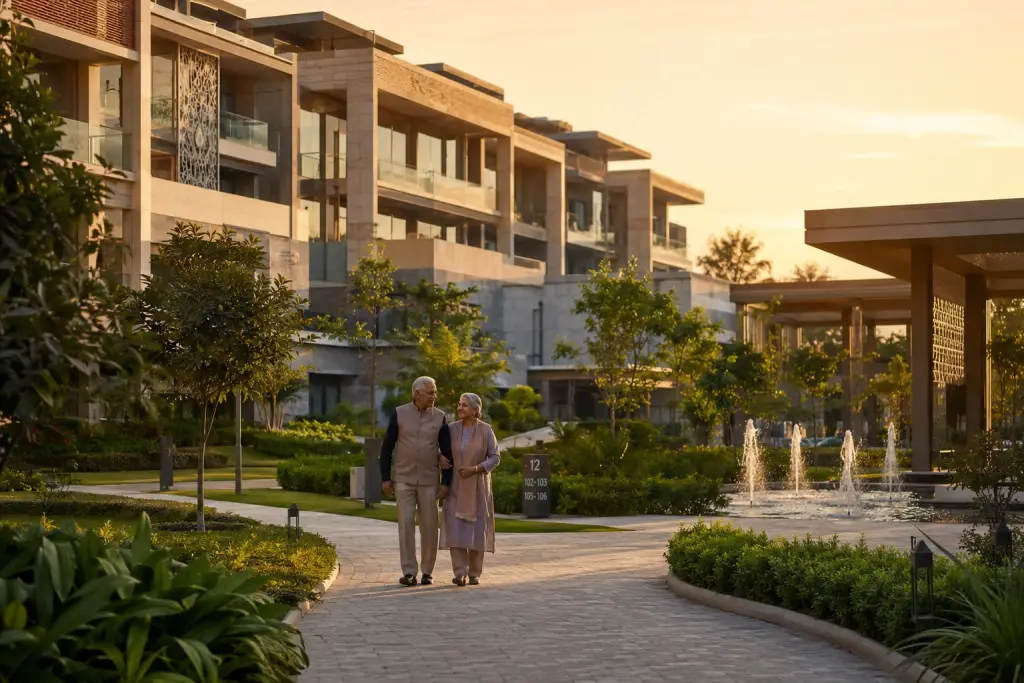
This is playing out at scale right now. India’s population aged 60 and above is expected to more than double over the next 25 years, from roughly 157 million today to around 346 million by 2050 — meaning nearly one in five Indians will be a senior citizen. Add to that the steady decline of joint family living, adult children scattered across cities and continents for work, and rising life expectancy, and you get a demographic shift that Indian housing simply wasn’t built for.
For decades, most families simply managed this on their own — a parent staying on alone in the family home, with children checking in from wherever they’d ended up. That model is increasingly out of step with how today’s seniors actually want to live — many are financially secure, socially active, and in reasonably good health, and want a lifestyle that reflects that, not just a safety net. A newer category has stepped into that gap: purpose-built senior living communities that pair independent housing with healthcare access, social infrastructure, and professional management.
Haryana, and Gurgaon specifically, has become one of the most closely watched markets for this category in North India. This guide covers what senior living actually is, why Haryana is positioning itself as a hub, what the state’s recently revised retirement housing policy means in practice, what these communities cost, and how to evaluate one without rushing the decision. It’s written for the people usually making this call under pressure — adult children searching on behalf of parents, NRIs managing it remotely, and retirees planning their own next chapter.
What Senior Living Actually Means
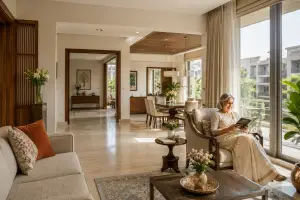
The term gets used loosely, and often undersells what the category actually is. Senior living properly refers to residential communities built specifically around the needs of older adults — the design, staffing, and services are planned around ageing from the start, not bolted on afterward.
It isn’t one product. It spans four broad models, each suited to a different stage of health:
- Independent Living — for active, largely self-sufficient seniors. Residents own or lease their apartment within a community offering age-friendly design, security, housekeeping, and social programming, without daily medical supervision built in.
- Assisted Living — adds structured support for things like medication management, mobility assistance, or regular health checks, while residents still live semi-independently.
- Memory Care — a specialised model for residents with dementia or cognitive decline, with secured environments and trained staff. Still fairly early-stage in India.
- Continuing Care — combines two or more of the above on one campus, letting a resident move from independent living into assisted care as needs change, without relocating. Considered the gold standard internationally, and increasingly the direction Indian developers are headed.
| Model | Best suited for | Support level | Setting |
|---|---|---|---|
| Independent Living | Active, self-sufficient seniors | Minimal | Private apartment, shared amenities |
| Assisted Living | Seniors needing help with daily tasks | Moderate, structured | Private/semi-private unit, staff support |
| Memory Care | Residents with cognitive decline | High, specialised | Secured environment |
| Continuing Care | Those planning to age in place | Scales over time | Integrated campus |
The question worth asking isn’t whether senior living makes sense — it’s which of these models fits where your parents are today, and where they’re likely to be in five or ten years.
Why Haryana, of All Places
Haryana’s rise here isn’t a fluke. It sits at the intersection of a few things that matter specifically for senior housing.
Proximity to Delhi NCR counts for more in this category than in ordinary housing — children working in Gurgaon, Delhi, or Noida want parents close enough for a weekend visit, not a flight away. Gurugram, Faridabad, and increasingly Sonipat offer that closeness without Delhi’s density.
Connectivity backs this up. IGI Airport is a short drive from most of Gurgaon, which matters for NRI families flying in for visits or emergencies. The metro, the Dwarka Expressway, and NH-48 have made large parts of the city genuinely accessible over the past decade — not just on paper.
Then there’s healthcare, probably the single biggest factor. Gurgaon and Delhi NCR host some of North India’s most established hospital networks, with cardiac, orthopaedic, and emergency capacity that directly matters for an ageing population. Several senior living projects have already built formal tie-ups with nearby hospitals — priority access, on-call support — a model that’s hard to replicate in smaller towns with thinner healthcare infrastructure.
And the buyer base helps: Gurgaon’s corporate ecosystem has produced a generation of financially comfortable, insurance-covered parents whose children are frequently settled abroad. That’s exactly the profile premium senior living depends on commercially.
What’s changed most recently, though, is that the state government has started legislating directly in this space.
The Retirement Housing Policy — What Actually Changed
Haryana was among the first North Indian states to introduce a dedicated Retirement Housing Policy, notified under the Haryana Development and Regulation of Urban Areas Act, 1975, and run by the Department of Town and Country Planning. The original policy laid out ground rules — plot sizes between 0.5 and 10 acres, residential-zone restrictions, and mandatory RERA registration before any apartment could be sold.
In 2026, the Haryana Cabinet under Chief Minister Nayab Singh Saini approved a meaningful amendment: raising the permissible Floor Area Ratio (FAR) for retirement housing colonies from 2.25 to 3.0, made available through Transferable Development Rights. This followed pressure from industry bodies, including the BRICS Chamber of Commerce and Industry, who argued the old FAR ceiling made dedicated senior housing financially unworkable on Gurgaon’s expensive land.
In plain terms, FAR decides how much you can build relative to plot size. Going from 2.25 to 3.0 is roughly a one-third increase in buildable area on the same land — which sounds technical until you see what it changes for buyers.
Senior housing eats up expensive, low-revenue space — wide corridors, medical suites, community halls, open landscaping — that developers previously had to squeeze into a tight FAR limit. That discouraged serious players from entering the segment at all. A higher FAR gives room for both that infrastructure and a commercially sensible number of units, which is already pulling larger, more established developers into a space that used to be dominated by small, niche operators. For buyers, that generally means better construction quality and stronger RERA accountability. It also means fuller communities — dedicated healthcare wings, bigger wellness and dining spaces — instead of compact, amenity-thin projects.
To keep the transition orderly, the higher FAR only applies to projects meeting norms tied to the state’s October 2020 framework, and applications already in the pipeline continue under the 2024 policy as it stood.
One thing worth remembering here: a higher FAR fixes a developer’s viability problem. It doesn’t automatically fix quality. Industry voices covering the amendment have pointed out that execution — staffing, medical response, day-to-day service — is still what separates a good community from a large one. Expect more launches across Gurgaon over the next two to three years as economics improve. That’s a reason to compare projects more carefully, not less.
Gurgaon’s Case for the Title
Within Haryana, Gurgaon is clearly where most of this activity is concentrated, and it’s not just about location on a map.
The healthcare density is real — multiple multi-specialty hospitals with the emergency, cardiac, and orthopaedic capacity most relevant to older residents, several with direct partnerships already built into senior living projects. The residential market is already premium and established, with corridors like Golf Course Road and Dwarka Expressway offering the gated security and management culture senior housing depends on. The corporate and NRI base means a large share of the city’s residents have children working in the same city, in Delhi, or overseas — which is really what makes senior living viable both emotionally and commercially. And connectivity — metro, NH-48, the airport — gives Gurgaon a profile few other NCR towns can match.
Layer onto that a genuine supply gap. India’s organised senior living penetration sits at around 1%, against double-digit figures in mature markets like the US and UK, with a projected shortfall running into millions of units by 2030. Gurgaon, with strong demand and now-improved supply economics, is positioned to absorb a large share of whatever gets built next — even as southern cities like Bangalore and Chennai remain established players in their own right.
Why It Actually Helps
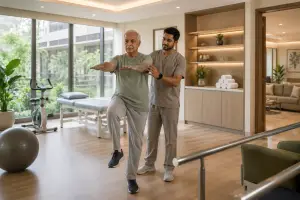
Beyond convenience, the case for senior living breaks down into a few distinct benefits. Barrier-free design — ramps, grab rails, non-slip flooring — cuts down on the falls that are a leading cause of injury among seniors living alone. On-site or nearby medical support catches problems faster than a standalone home ever could. Structured social calendars help counter the isolation that’s strongly linked to cognitive decline and depression. Gated access and staffed reception offer a level of security hard to replicate in an individual house. Housekeeping, meal services, and transportation let residents stay active without carrying the physical load of running a household. And for families — especially those living elsewhere — there’s a real, if underrated, benefit: a support system they can rely on and check in on remotely, instead of a constant background worry about what happens if no one’s there.
Independent vs Assisted Living
| Independent Living | Assisted Living | |
|---|---|---|
| Daily support | Minimal | Structured |
| Medical monitoring | On request or emergency | Built into the model |
| Best for | Active, self-sufficient seniors | Those needing help with daily tasks |
| Cost | Generally lower | Higher, given added staffing |
If your parents are healthy today but you’re thinking 10–15 years ahead, ask specifically whether a project offers a continuum of care — the option to move into assisted living on the same campus later, rather than relocating entirely.
What a Genuinely Good Community Looks Like
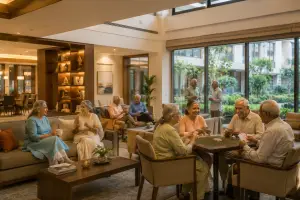
The marketing brochures tend to blur together after the third or fourth project. What’s worth actually verifying: 24/7 emergency response with trained on-site staff, not just a call centre number; a named hospital partner with documented response times, not a vague “close to healthcare” claim; physiotherapy and wellness support; dining that can flex around medical and dietary needs; barrier-free design throughout, not just in common areas; real security — CCTV, staffed reception, visitor management; and some form of digital healthcare integration, whether that’s telemedicine or health tracking. Ask to see a finished or near-finished project, not a sample flat, and if you can, talk to a resident’s family.
What This Actually Costs
Pricing varies a lot — by location, developer, unit size, and how much service is bundled in. Corridors near central Gurgaon command a premium over developing stretches like parts of Dwarka Expressway, largely because land cost flows straight into the sale price. Rather than quoting numbers that shift with every new launch, it helps to know what you’re actually paying for: the unit itself, ongoing maintenance (usually higher than standard residential, since it funds healthcare staffing and wellness programming), optional care packages billed separately, one-time club or amenity fees, and sometimes a preferential-access healthcare arrangement instead of a flat fee. Because the segment is still maturing here, these structures aren’t standardised across developers yet — get a line-by-line breakdown before comparing projects on price alone.
Is It a Good Investment?
For investors, the demand case is unusually strong for such a young asset class. The demographic trend is essentially locked in — it’s driven by people already born, not speculative future growth. Supply is scarce, with organised penetration around 1% against a shortfall of millions of units by 2030. Market size estimates put India’s senior living sector growing from roughly $3.5–4.5 billion in 2025–26 to $12–14 billion by the early 2030s, among the fastest growth rates in Indian real estate. And policy is now actively supportive, not neutral — Haryana’s FAR revision is a clear signal of that shift.
What’s thinner is the track record. Resale and rental data for organised senior living in India are still forming, simply because the category is new. Treat it as an emerging asset class with strong structural tailwinds, not a fully mature category with years of comparable yield data behind it — returns will hinge on developer execution and location, not demand trends alone.

Myths Worth Retiring
A few misconceptions come up in almost every family conversation about this. It isn’t only for unwell or dependent seniors; most residents of independent living communities are healthy and choosing the lifestyle proactively. Moving in doesn’t mean giving up independence — that’s the whole point of the independent living model. It isn’t a sign the family doesn’t care; often families choose it precisely because they do, recognising that healthcare access and a genuine community serve parents better than staying on alone in an oversized house. It isn’t a single price tier — premium developments span a real range depending on location and services, not one fixed ultra-luxury bracket. It isn’t isolating; well-run communities are built around social engagement, activity calendars, and shared spaces. Buying in doesn’t mean you’re stuck — resale is generally possible through standard processes. And it isn’t only for people without children — plenty of residents have kids who are simply working elsewhere and want their parents in a well-supported lifestyle nearby.
Before You Sign Anything
Confirm RERA registration independently rather than taking a sales pitch’s word for it. Check the developer is specifically licensed under Haryana’s Retirement Housing Policy. Get clarity on what’s included in base maintenance versus billed separately. Ask for the named healthcare partner and their actual response times. Ask about staff-to-resident ratios, especially for assisted living. Check whether the campus offers a continuum of care. Look into the developer’s delivery track record — has this team built senior living before? And ask about resale and exit terms before you need them.
Where Buyers Trip Up
The most common mistake is buying off a brochure without visiting a live project. Close behind is underestimating recurring costs — the purchase price is only the entry point over a decade of ownership. Some buyers focus entirely on the developer’s brand and skip checking who actually manages the facility day to day, which is a different skill from construction. Others make the decision without involving the parent who’ll actually live there, which tends to backfire. “Near a hospital” gets mistaken for a formal medical partnership, which it isn’t unless it’s documented. And more often than you’d expect, families rush the whole decision after a health scare, instead of comparing options while there’s still time to think clearly.
Notable Projects in the Market Today
A quick, non-ranked look at what’s currently active in Haryana — none of this is an endorsement, and details shift fast enough that everything here should be verified directly with the developer before any decision.
DLF Senior Living, Sector 63A on Golf Course Extension Road, comes from one of India’s largest listed developers and sits in an already-established premium corridor. Pioneer Advait, in Sector 50’s Nirvana Country, is a Pioneer Urban–JK Organisation joint venture reported to carry IGBC Platinum certification and a licensed status under the state policy, with a hospital tie-up nearby. Max Antara Estate on Dwarka Expressway follows an “intergenerational estate” model, folding senior living into a broader residential township under the Antara brand. JMS Silver Living in Sector 95 is a dedicated senior community from JMS Group, tapping into the city’s westward infrastructure growth. Smaller and regional developers continue entering the segment across Sohna Road and Faridabad, part of the broader momentum following the FAR change.
Given how quickly this segment is moving, treat brochure pricing and possession dates as a starting point for a conversation, not a final answer.
Frequently Asked Questions
What is senior living? Purpose-built residential communities for older adults, ranging from independent living to full assisted care, designed around ageing rather than retrofitted for it.
Who is senior living actually designed for? Financially independent, active seniors who want ownership, privacy, and a premium lifestyle, alongside healthcare access and community — not a service arrangement, but a home.
Is it only for elderly people who are unwell? No — most independent living residents are healthy and active, choosing it for convenience and community rather than necessity.
Why is Haryana becoming a hub for this? Proximity to Delhi NCR, Gurgaon’s healthcare infrastructure, an affluent NRI-linked population, and now direct state policy support.
What changed in the 2026 policy? The permissible FAR for retirement housing colonies rose from 2.25 to 3.0 via Transferable Development Rights, improving project economics for developers.
Why does FAR matter to buyers, not just developers? It lets developers build fuller, better-resourced communities on the same land instead of cramming in units to stay profitable.
Why Gurgaon specifically? Its combination of premium real estate, dense private healthcare, connectivity, and a corporate/NRI population is hard to match elsewhere in the state.
Independent vs assisted living — what’s the real difference? Independent living suits active seniors needing minimal help; assisted living adds structured daily support for those who need it.
What is memory care? A specialised model for residents with dementia or cognitive decline, offering secured environments and trained staff.
What is a continuing care community? One campus offering multiple care levels, so residents can move from independent to assisted living without relocating.
How much does senior living cost in Haryana? It varies by location, developer, and bundled services — there’s no single standard figure across the market.
Is it a good investment? The demand case is strong, but it’s an early-stage asset class with limited resale and yield history compared to conventional residential property.
Can NRIs buy senior living property here? Generally yes, through NRE or NRO accounts under standard FEMA rules — worth confirming specifics with a legal or financial advisor.
What amenities should I look for? 24/7 emergency response, a documented hospital partnership, barrier-free design, security, and genuine social programming.
How do I verify a project is legitimate? Confirm RERA registration, check licensing under Haryana’s Retirement Housing Policy, and visit a live or near-complete project.
Is senior living right for parents who are still very active? Often yes — independent living is built specifically for that profile, not just for those needing care.
What is the “silver economy”? The broader economic activity generated by an ageing population, spanning healthcare, real estate, and lifestyle services — senior living is one of its fastest-growing slices.
How does Haryana compare to South Indian cities in this space? Southern cities got there earlier, but Gurgaon is now catching up fast, helped by fresh policy support.
Is healthcare usually on-site or nearby? Most premium projects rely on formal hospital tie-ups rather than in-house hospitals — worth checking which model a project actually follows.
How do I choose between several Gurgaon projects? Compare location, healthcare partnerships, developer track record, what’s actually included in the price, and, where possible, feedback from existing residents.
Where This Leaves You
Choosing a senior living community is rarely just a property decision — it’s a decision about how someone will actually spend their later years. Haryana’s push into this space, backed by real healthcare infrastructure, NCR connectivity, and now a policy built specifically to support it, makes it worth taking seriously.
But none of that replaces due diligence. Not every project will deliver what its brochure promises, and the right fit depends on specifics — a parent’s health, their social preferences, how involved the family wants to stay. If you’re exploring senior living in Haryana or Gurgaon, talking to an experienced real estate advisor can help you compare communities on lifestyle, healthcare, location, and long-term suitability — so the decision gets made with clarity, not urgency.